




India
Ultimate Wildlife Safari 13-Day: Leopards, Tigers & Palaces
2026
Group Departures
$5,498
6 person minimum
Go On Your Own
$5,898
2 person minimum
Intra-Trip Flight Package
+ $998
Subject to change until issued.
Add $350 for peak week/high season departures in December and January
Prices based on exchange rate as of July 2025.
Exchange rates are subject to change without notice, and additional currency equalization fees may be required at the time Wild Planet pays for local services, which may occur up until 30 days prior to departure – even if you have already made your final payment.

A Little More Info
SINGLE SUPPLEMENT
Single travelers staying in a room by themselves will be charged this additional single supplement fee, as all of our regular prices are otherwise based on double occupancy.
SINGLE SHARE OPTIONS (if available)
If you are traveling alone and wish to share a room, we will make every effort to find you a roommate of the same gender, in which case you will not have to pay the single supplement fee. The single supplement will be charged until we are able to confirm a roommate for you. If we are able to match you with a roommate, the single supplement will be refunded. In the event that we cannot find a share for you, you will be required to pay the single supplement fee.
New: Click the Singles Find a Share' icon below or check our "Community" page to connect with other single travelers looking to share.

 Questions? Chat with a Regional Specialist
 News and Specials
 Email Trip to a Friend
 Singles: Find a Share


India
Ultimate Wildlife Safari 13-Day: Leopards, Tigers & Palaces
Destinations
- Delhi
- Jodhpur
- Siana
- Jaipur
- Bharatpur National Park
- Agra / Taj Mahal
- Kanha National Park
Highlights
- Leopard Safari - by Camel-back & Jeep in Siana
- Tiger Safari - by Jeep in Kanha National Park
- Keoladeo Bharatpur National Park - One of 4 UNESCO World Heritage Sites
- Sloth Bear Rescue Center - Conservation Project for Dancing Bears
- Visit Bishnoi sect of Hindus who revere wildlife as part of their religion
- Agra - The Taj Mahal
- Jodhpur - The Blue City, Mehrangarh Fort and Royal Palaces
- Jaipur - The Pink City, City Palace, Observatory and Palace of Winds
- Temples, Palaces, local cooking demonstrations, folk music & more
- A combination of 4 and 5-Star Hotels, Top Safari Lodges, Boutique Hotels and Classic Safari Tented Camps
- Maximum wildlife viewing
- Expert local naturalist guides and trackers
Itinerary at a Glance
- DAY 1 Delhi
- DAY 2 Jodhpur Meet Bishnoi sect of Hindus
- DAY 3-4 Siana Leopard Safari by Jeep & Camel
- DAY 5 Jaipur Amber Fort, City Palace, Observatory & Palace of Winds
- DAY 6 Bharatpur National Park Safari by Rickshaw & Foot
- DAY 7 Agra Sloth Bear Rescue Center, Taj Mahal
- DAY 8 Taj Mahal / Raipur
- DAY 9-12 Kanha National Park Tiger Safari
- DAY 13 Delhi

Ultimate Wildlife Safari 13-Day: Leopards, Tigers & Palaces
This is our award-winning Northern India wildlife adventure, named one of the "World's 50 Best Trips" by National Geographic Traveler, "Best New Trips of 2009" by National Geographic Adventure, and "Best New Trip" by Smarter Travel. It features many of Wild Planet's special touches:
- More destinations, and more value than nearly any other professional wildlife tour, including over 10 distinct destinations such as national parks, wildlife refuges, private wildlife reserves, cultural and historical sites, as well as 4 UNESCO World Heritage Sites!
- Expert Local Naturalist Guides
- Fine Hotels and Classic Indian Safari Camps - A combination of 4 and 5 star hotels, top safari lodges and fully equipped traditional deluxe safari camps (complete with beds and amenities.)
- Specifically designed to optimize the chances of seeing more wildlife by visiting a variety
of different eco-systems, with no commercial "filler" activities.
Detailed Itinerary
DAY 1-3 Delhi / Siana Leopard Safari / Bishnoi Cultural Exchange / Jodhpur
Highlights: Leopard safari by jeep and camels. Cultural exchange with a Hindu sect who revere wildlife as part of their religion.
Wildlife: Leopards! Plus rare blackbuck antelope, Indian striped hyenas, jungle cat, desert cat, chinkara, desert fox, blue bull, and more.
Wild Planet Adventures Exclusive!
Start your adventure with classic jeep safaris to see leopards and other wildlife and an excursion by camel-back. A small population of wild leopards inhabit the hills surrounding Siana, a small shepherd village untouched by western influence. The leopards are commonly seen on our camel-back and jeep safaris, and with luck we may even see them hunt. Our trust fund compensates the shepherds if a leopard kills a sheep, so the shepherds no longer try to kill the leopards. Safaris by jeep as well as foot and camel-back options each morning and evening so you have the best possible chance seeing the leopards.
What makes Siana so special is that it’s NOT a national park or protected area. It's a small village in a very remote area, where eco-tourism plays a critical role in helping the local people live in harmony with the small population of leopards that inhabit the rocky hills surrounding the village. Leopard sightings are possible, but not as easy as they would be in a National Park, and therefore our focus is as much on the cultural experience as the leopards.
Besides the elusive leopards we can also see Indian striped hyenas, jungle cat, desert cat, chinkara, desert fox and the blue bull. Enjoy a choice of two nights at a traditional stand-up deluxe safari camp (with beds and amenities) on a dune with a spectacular view of the Aisrana valley, or at the Siana Gardens Lodge. (Groups must stay together.)
On our way to Siana we will first fly to the "Blue City" of Jodhpur, named for its eye-catching pale blue clay houses. We'll visit the Mehrangarh fort and its royal palaces. The spectacular Mehrangarh fort crowns a perpendicular cliff that overlooks the city, its royal palaces strategically placed to guard the city below. It was founded by Rao Jodha in 1459 AD. We'll admire the fort complex and the handsome royal palaces within its walls, each containing collections of priceless jewels and armor.
We will also stop in Doli where we will meet and interact with the Bishnois, a sect of Hindus who revere wildlife as part of their religion. The Bishnois do not allow any killing of wildlife or cutting of trees. Large herds of rare blackbuck antelopes and other wildlife can be seen grazing near their homes, totally unafraid. There are instances where Bishnoi women have nursed young antelopes along with their own children. Government officials acknowledge that the Bishnois have been far more effective against poachers than any other official conservation effort. A historic test for the Bishnois came 250 years ago when a Maharajah sent troops to cut timber for a palace he was building. The Bishnois hugged the trees, upholding their faith and defying the soldiers. More than 300 were massacred before the king, learning of the slaughter, ordered his troops to stop.
The villages of Siana and Doli show very little western influence and are still very traditional. They offer a truly authentic experience of the rich culture of this region. You will be invited into local homes for a taste of the lifestyle of the shepherds. This community still clings to tradition and is very distinctive in their appearance. One afternoon you will also enjoy a very special cooking demonstration by your host family to learn how to use traditional Indian spices. Our talented host family will also provide an evening of authentic folk music.
DAY 4-5 Jaipur, the "Pink City" / Amber Fort / City Palace / Observatory / Palace of Winds
Transfer to Jaipur by train - a quintessential Indian experience (although most Indians do not get to enjoy the first-class A/C compartments!) Visit the ancient Amber Fort, the Observatory and the Palace of Winds in the rose-pink capital of Rajasthan, aptly named the "Pink City of India." Jaipur is surrounded on all sides by rugged hills that are crowned with forts. Enclosed by embattled walls, the city was built early in the eighteenth century. The Maharaja's palace stands in the center of the city amidst lovely gardens. Houses with latticed windows line the streets, their rose-pink color lending enchantment to the scene, which is almost magical at sunset. Jaipur is aptly called the "Pink City of India". It takes its name from the famous Maharaja Sawai Jai Singh, who founded the city in 1728. A keen astronomer, he built an observatory which still exists and is equipped with quaint masonry instruments of remarkable size.
Jaipur is noted for its craftsmen skilled in the art of cutting precious stones and famed for its garnets and rubies. It is equally well known for brass inlay work, lacquer work and the printing of muslins. Enjoy a city tour to the Observatory and the local markets. The Observatory was built in the 17th century by Jai Singh and is in the middle of the Ram Niwas Palace Gardens. The Observatory features a sundial 90ft. high and a Museum founded in 1876 with a large collection of antiques.
We'll continue our tour of Jaipur with a tour of the City Palace and Palace of Winds. The City Palace houses a museum containing rare manuscripts, paintings and an armory. The Palace of Winds (Hawa Mahal) is a landmark of Jaipur. Its unique design is made of pink sandstone. Later that afternoon we'll drive to Bharatpur. Bharatpur was founded by Maharaja Suraj Mal in 1733 AD, and is known as The 'Eastern Gateway to Rajasthan'. It was once an impregnable, well fortified city, carved out of the region formerly known as Mewat.
DAY 6 Agra / Bharatpur - Keoladeo National Park
Wildlife: 400 species of birds, golden jackal, striped hyena, fishing cat, jungle cat, nilgai, sambar, blackbuck, wild boar, otters, monitor lizards, Indian pythons.
After breakfast drive to Agra, visiting Fatehpur and Bharatpur Keoladeo National Park en route. Enjoy game viewing in Keoladeo National Park by rickshaw - the best way to see the park's wildlife. The Bharatpur Wildlife Sanctuary is home to 400 bird species. The park's shallow waters and marshes provide an oasis in the heart of the desert and have become an important stopover for a variety of migratory bird species from Central Asia and even Eastern Europe. It is also an excellent place to watch mammals like golden jackal, striped hyena, fishing cat, jungle cat, nilgai, sambar, blackbuck and wild boar. The park is also rich in otters, monitor lizards and during the cool winter months it is also possible to see large Indian pythons sunning themselves. Continue to Agra and overnight.
DAY 7 Agra / Sloth Bear Rescue Center / Sur Sarovar / Taj Mahal
Morning visit at the Sloth Bear Rescue Center with birding at Sur Sarovar (Keetham Lake). Evening visit Taj Mahal at sunset, a magical experience.
The Sloth Bear Rescue Center at Sikandra (Agra) is an incredibly heart-filled experience. Here we'll visit a renowned Dancing Sloth Bear rescue center. See many sloth bears, interact wildlife experts, and contribute to rescue and conservation efforts for the Dancing Sloth Bears and to re-train their Gypsy owners.
SLOTH BEAR RESCUE CENTER: Dancing Bears are Indian Sloth Bears (protected under the Indian Wildlife Protection Act) that have been exploited for the past 300 years by the members of nomadic 'Kalandar Community' for a cruel and barbaric 'Bear Dancing' trade -- a form of street entertainment. Even until a few years ago, the Taj Mahal as well as the road to Fatehpur Sikri witnessed this remnant of a brutal tradition left behind from the Mughal period. Gypsies would accost tourist cars and buses with a trained bear in tow and make the bear dance for a few dollars. In the Mughal period this was a source of entertainment for the Mughal emperors and their harem. Bears are trained by gypsies using cruel techniques of piercing their muzzle with a red hot iron needle and made to dance on hot coals. They spent their lives suffering at the end of a short rope and performing a "dance of pain".
Wildlife S.O.S adopted a unique approach to end the cruel tradition of 'Dancing' bears. The Bear owner (often hailing from a disadvantaged 'Kalandar' community) is trained in an alternative profession while the rescued bear is taken to her new home at the rescue facility. To date, more than 600 bears have been rescued from a life of pain and suffering. Today these bears spend their lives snacking on fruits and honey, learning how to climb trees, frolicking in ponds and exploring the natural environs of the rescue centers. This compassionate and sustainable approach of rescuing "dancing bears" while simultaneously rehabilitating the Kalandar Community (who have been dependent on the bears for their livelihood) has been extremely successful. The famous Delhi-Agra-Jaipur Highway and the areas around Fatehpur Sikri and Sikandra have now been completely cleared of "Dancing bears".
The contribution of Wild Planet's guests helps to rescue the remaining dancing bears off of Indian streets and contributes to ultimately stopping the poaching of sloth bear cubs from the wild, thereby conserving the wild population, too.
DAY 8 Taj Mahal / Agra Fort / Raipur
In the morning visit the majestic Taj Mahal at sunrise, a breath-taking sight. The Taj was built by Emperor Shah Jahan in memory of his beloved consort Mumtaz Mahal. One of the Seven Wonders of the World, this beautiful mausoleum is pure white marble and an architectural marvel. Alternately you can choose to enjoy bird watching at the Yamuna River. Later transfer back to Delhi in time for your flight to Raipur.
DAY 9-12 Kanha National Park / Project Tiger / Tiger Safari
Highlights: Tiger safari by jeep in the land of Rudyard Kipling.
Wildlife: Tigers! Plus langurs, jackals, barking deer, sloth bear, jungle cats.
The best park in India to see tigers, Kanha is also the setting for Kipling's "Jungle Book". We'll travel by jeep (for tiger viewing) though beautiful forest and lightly wooded grasslands with many rivers and streams. Kanha is one of the largest national parks, and is part of Project Tiger, one of India's most important conservation efforts. Kanha supports an excellent variety of wildlife including endangered hard-ground barasingha. Barking deer, spotted deer, gaur, golden-backed jackal, jungle cat, common langur, sloth bear, wild boar, wild dog and the elusive chausingha.
DAY 13 Delhi
Return to Delhi in time for night flights back home.
Trip Extensions
Corbett National Park
India's first national park, cradled in the foothills of the Himalayas at 3300 feet above sea level, spreads over an area of 520 sq km. The magnificent Ramganga River flows through the entire length of the Park. Corbett has one of the highest densities of tigers in India. Other mammals include the leopard, elephant, bear and deer. Basking along the banks of the Ramganga are the slender snouted gharial and the marsh crocodile. There are watch towers, elephant safaris and jeep safaris for wildlife viewing.
Assam / Kaziranga / Manas National Parks
Highlights: Rhino Safari by elephant-back and jeep in Kaziranga. Rare wildlife raft safari on the Bhorelli River in Nameri to view rare wildlife.
Wildlife: Rhinos! Also, hoolock gibbons, gangetic dolphins, water buffalo, swamp deer.
Kaziranga National Park
Kaziranga is famous for its Indian rhinoceros population, which is estimated at 1,100+ and is by far the best place to see them in India. Other large mammals include the water buffalo, swamp deer and gangetic dolphin. We use both elephants and four-wheel drive jeeps for our sunrise and sunset safaris into the park, as well as visits to several watchtowers set up in prime locations for wildlife-viewing.
Kaziranga National Park lies to the south of the mighty Brahmaputra River and being on the floodplains it is inundated heavily by the monsoon rains. The predominant vegetation is a mixture of tall grasslands and riverine forests. There are many marshes, interconnecting streams and ox-bow lakes, known locally as 'bheels' or 'bils'. The nearby Panbari Reserve Forest is the best place to see the Hoolock Gibbon. To the south of the park lie the Mikir Hills which rise to over 3,000 feet in elevation. Kaziranga's many bird species, including colonies of spot-billed pelicans and rare Bengal floricans, inhabit the grasslands. Nearby, tea plantations grow famous Assam tea.
Manas National Park
Located in the Himalayan foothills in the western Assam, Manas was originally a game reserve since 1928 and became a Tiger Reserve in 1974, a World Heritage Site in 1985, a Biosphere Reserve in 1989. Then declared as a National Park in 1990 with an area of 500 sq. kilometers and also the core area of 2600 sq. kilometers of Chirang Ripu Elephant Reserve. The park harbors more than 20 endangered species and is famous for its unique scenic beauty. It is also an Important Bird Area.
Flora: Manas forest is possibly as diverse as a natural biosphere can be. Its vegetation ranges from tropical semi-evergreen forests in the northern parts to tropical moist and dry deciduous forests of the other regions. There are extensive alluvial grasslands in the western region of the park, which comprises a variety of different grasses and shrubbery. There is also a considerable variety of aquatic flora along the Manas River.
Fauna: Mammals: Rhino, elephant, tiger, pygmy hog, hispid hare, golden langur, Assamese macaque, rhesus macaque, leopard, golden cat, clouded leopard, fishing cat, leopard cat, jungle cat, the large Indian civet, the small Indian civet, common palm civet or toddy cat, Himalaya palm civet, binturong, common mongoose, small Indian mongoose, Himalayan black bear, sloth bear, gaur, water buffalo, sambar, hog deer, barking deer, swamp deer, wild pigs etc.
Custom Extensions
Don't see what you're looking for? Wild Planet has a full-service office in Delhi, so we can arrange an extension to any destination in India, offering the same quality of service and often with your same top naturalist and cultural guides on our staff that you'll enjoy throughout the rest of your trip. Please call us and ask about your preferred destinations.
India Lodging
Our Ultimate Wildlife itinerary specializes in quality lodging with an emphasis on the highest quality meals possible for a safe and comfortable - even luxurious - stay in India. Great care has gone into our selection of lodging partners, with particular emphasis on lodges that offer outstanding wildlife viewing opportunities. These special lodges offer all the comforts of home and pamper you with delicious local Indian regional specialties. Our meals are sometimes extravagant, always healthy, and can cater to most special dietary needs.
DELHI


Radisson Blu Plaza Delhi
The Radisson Blu Plaza Delhi is located only five kilometers from Indira Gandhi International Airport and offers Delhi visitors 261 modern rooms and suites with amenities like LCD televisions and free wireless Internet. Guests can also enjoy unlimited kababs at The Great Kabab Factory and all-day dining at NYC. A state-of-the-art gym makes it easy to keep up with your workout, and the luxurious on-site spa helps melt away the stress of the day.
SIANA


Siana Garden Lodge (Alternative - Additional Cost)
Siana Garden Lodge offers 15 suites-style cottages with all-modern amenities, is about 45 minutes away from Siana tented camp and can be used as an alternative for those travelers who do not want to stay at the tented camp. It is also sometimes used for your arrival night in this area depending upon your logistics


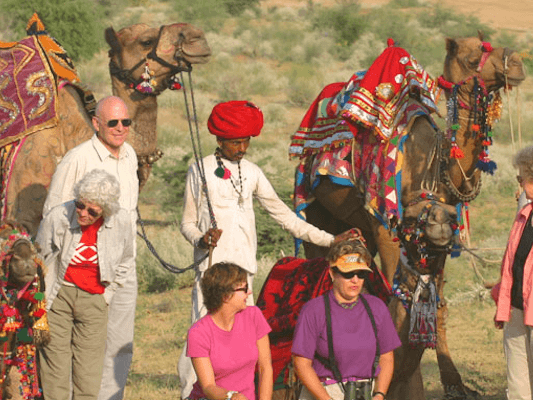
Camp Aisrana (Primary)
As the name suggests, this is a camp situated away from any habitation or settlement. Located atop a dune, it offers a commanding view of the Aisrana Valley. These camps are an ideal getaway for those wishing to relax and unwind after a hectic city life. The air is fresh and absolutely pollution free. These camps are totally eco-friendly and in tune with the surrounding countryside.
JAIPUR


Trident Hotel, Jaipur
Breathtaking views of the serene Mansagar Lake and the striking Aravalli range welcome guests at the 134 room Trident Hotel, Jaipur. Situated en route to Jaipur's famous Amber Fort, the Trident, Jaipur offers gracefully furnished rooms that are well-equipped.
AGRA


Trident Hotel, Agra
Trident, Agra, set amidst beautiful gardens, fountains, landscaped central courtyards, is built of red stone reminiscent of the Mughal era. The Hotel is literally, a stone's throw away from one of the new 7 Wonders of the World, the Taj Mahal.
RAIPUR


Babylon International
Babylon International is the Gateway to the lush green & the dense forest state of Chattishgarh - Opening a vista of Nature's paradise with its flora & fauna and wildlife adventures.
Located a few miles from the Airport and within the heart of Raipur's new capital district, Hotel Babylon International offers a luxurious oasis of exclusive and elegant accommodations within the bustling & growing city. A warm welcome from our friendly and caring staff awaits as you are swiftly transported to the sumptuous surroundings of your pristine rooms & suites - your home away from home for the duration of your stay.
80 Elegantly appointed Suites & Rooms, coupled with the latest in high-tech entertainment and business facilities, makes the Babylon International a perfect choice for discerning visitors, wishing to enjoy high standards of excellence and the finest in Indian hospitality. Indulge yourself at our choice of lavish Buffets, Restaurants & Bar, which offers you a feel of Utopia.
A few minutes from the thriving shopping, business, and entertainment districts surrounding the G E Road, Babylon International offers you convenience and comfort. Wider travel is effortless, with major highways, business districts, and the airport all easily accessible from our prime location.
KANHA


The Baagh, A Forest Retreat
This resort is situated on the border of Kanha National Park, home to India's majestic tigers and numerous mammals, reptiles and bird species. The luxury property is surrounded by the park's jungles and traditional tribal villages in the Mandla district of Madhya Pradesh, a central Indian state. The Baagh Resort at Kanha provides refuge from the hectic world and an opportunity to enjoy the wonders of nature in the wilds of India. Here you'll experience the adventure of the jungle, magnificent scenery, the romance of brilliant sunrises and sunsets, and the comforts of home in your jungle retreat.
India Activities
At a Glance

We know you've chosen to travel with us for our wildlife emphasis, so we've included a wide variety of adventure activities designed to educate, inspire, and bring out the wonder in you. All of our activities are flexibly designed to accommodate different skill levels and interests, while exposing you to a variety of unique eco-systems in order to see the most amount of wildlife. And did we mention fun?
India Wildlife
Prolific Sightings

Wild Planet's wildlife safaris are designed for nature lovers and wildlife enthusiasts. Our "Ultimate Wildlife" safaris are specially designed for maximum wildlife viewing. We take care to seek out wildlife that is rare, off the beaten path, and in greater numbers than you will see on conventional tours.
Our expert naturalist guides will educate you in the field so your experience is intimate and unparalleled. Still, wildlife viewing can unpredictable and requires patience and sensory awareness. A partial list of some of the animals you are likely to see is below:
Primates: Macaque Monkeys, Langur Monkeys, Rhesus Monkeys
Other Mammals: Elephants, Rhinoceros, Wild Buffaloes, Muntjac, Chital, Nilgai Bluebuck Antelope, Sambar Deer, Mongoose
Reptiles: Monitor Lizards
Birds: 450 birds species including: Hornbills, Indian Rollers, Kingfishers, Marabou Storks, Cranes, Water birds of all kinds
Likely Sightings

Cats: Tiger, Leopards
Mammals: Sloth Bear, Striped Hyena, Golden Jackal, Otter, Wild Boar
Reptiles: Pythons, Gharial, Crocodile
Birds: Eagles, King Vulture, Siberian Crane
Rare or Endangered Possible Sightings

Cats: Fishing Cat, Jungle Cat, Desert Cat
Mammals: Chinkara, Desert Fox
Reptiles: Cobras
India Guides
Raj Singh

Master Naturalist, Head Guide and In-Country Coordinator
Acclaimed wildlife biologist Raj Singh is one of the world's leading authorities on wildlife in India. Cited by Lonely Planet and Frommers, and author of the 3 top field guides on India's wildlife and parks, Raj brings 25 years of unparalleled expertise to Wild Planet's India programs. While we don't let him out of the office much to run trips these days, Raj hand-crafted Wild Planet's programs together with director Josh Cohen, and his touch can be found in every aspect of your trip. Raj coordinates our ground operations from Delhi, India.
Ansar Kahn

Naturalist Guide & Wildlife Photographer
Ansar was born at Bharatpur and comes from a family of foresters who have worked in the Keoladeo National Park for two generations. He is an expert photographer as well as a high-end naturalist guide, who has guided for both Wild Planet Adventures and National Geographic. Many of his photographs have appeared in magazines and books for the WWF (World Wildlife Federation). His expertise is as a bird and wildlife naturalist in the north and east as well as Bhutan.
Rajveer Singh

Master Naturalist Guide
Master Naturalist Guide Rajveer was born and brought up at Bharatpur near Keoladeo National Park where he first developed his interest in birds and animals. He graduated from the University of Rajasthan with an emphasis on nature and wildlife interpretation. Rajveer has led wildlife safaris for many years throughout India, Nepal and Bhutan, including groups from National Geographic, Wild Planet Adventures and some of the most prestigious natural history museums, universities and wildlife societies in the U.S.
India Departures
India-Ultimate Wildlife Safari 13-Day: Leopards, Tigers & Palaces


| Jan 11, 2026 - Jan 23, 2026 | 13-days | $5,498 |
| Jan 25, 2026 - Feb 06, 2026 | 13-days | $5,498 |
| Feb 08, 2026 - Feb 20, 2026 | 13-days | $5,498 |
| Feb 15, 2026 - Feb 27, 2026 | 13-days | $5,498 |
| Feb 22, 2026 - Mar 06, 2026 | 13-days | $5,498 |
| Mar 08, 2026 - Mar 20, 2026 | 13-days | $5,498 |
| Mar 22, 2026 - Apr 03, 2026 | 13-days | $5,498 |
| Oct 18, 2026 - Oct 30, 2026 | 13-days | $Call |
| Nov 01, 2026 - Nov 13, 2026 | 13-days | $Call |
| Nov 15, 2026 - Nov 27, 2026 | 13-days | $Call |
| Nov 29, 2026 - Dec 11, 2026 | 13-days | $Call |
| Dec 13, 2026 - Dec 25, 2026 | 13-days | $Call |
| Dec 27, 2026 - Jan 08, 2027 | 13-days | $Call |
| Jan 10, 2027 - Jan 22, 2027 | 13-days | $ Call |
| Jan 24, 2027 - Feb 05, 2027 | 13-days | $ Call |
| Feb 07, 2027 - Feb 19, 2027 | 13-days | $ Call |
| Feb 21, 2027 - Mar 05, 2027 | 13-days | $ Call |
| Mar 07, 2027 - Mar 19, 2027 | 13-days | $ Call |
| Mar 21, 2027 - Apr 02, 2027 | 13-days | $ Call |
| Oct 17, 2027 - Oct 29, 2027 | 13-days | $ Call |
| Oct 31, 2027 - Nov 12, 2027 | 13-days | $ Call |
| Nov 14, 2027 - Nov 26, 2027 | 13-days | $ Call |
| Nov 28, 2027 - Dec 10, 2027 | 13-days | $ Call |
| Dec 12, 2027 - Dec 24, 2027 | 13-days | $ Call |
| Dec 26, 2027 - Jan 07, 2028 | 13-days | $ Call |
India FAQ
India Facts for Visitors


Climate/Best Time to Go
India is a huge subcontinent and has distinct seasons for the Central Plains, the far Northern Himalayas, the eastern Assam Region, and the Southern Peninsula. The monsoons start slowly in the south in early June, and work their way up the peninsula by July. They are usually done by late Sept or Oct. Best time to go for our Leopards, Tigers and Palaces Safaris: Early November through April. Trips after April are possible until late June, but may be hotter.
Indian Visa
Visa requirements and validity change quite often. The following is only a guide to the requirements at the time of writing. Before applying you should check with the Indian Embassy or Consulate in your own country about the latest regulations and fees.
All foreign nationals, except those of Nepal and Bhutan require a visa for entry into India. Tourist visas are issued for a period of six months and are valid from the date of issue. You should not apply for your visa too early. You need to make sure its validity covers your entire trip. Always specify that you require a multiple entry visa, for which there is no extra charge.
The best way to get your visa is online on the India government site https://indianvisaonline.gov.in/visa/tvoa.html. The cost of a visa varies and often depends on your nationality and the current relationship between India and your country. Note that you can only apply for the visa starting 34 days before your arrival date, and the processing time is 3 business days.
Documents
Always carry your passport with you. This is normally required when changing money or checking into a hotel. A valid certificate of inoculation against yellow fever is necessary if coming from an affected area. No other health certificates are required.
Vaccinations
It is highly advisable to take all possible precautions against diseases that you may come in contact with while traveling in India. Currently recommended vaccinations are against Tetanus, Typhoid, Polio, and Hepatitis A. Vaccination against Rabies may also be worth considering. Smallpox has been eradicated and immunization is not necessary. Vaccination against Cholera is no longer required, recommended or even available in most countries. Malaria is a serious problem in some regions and you should take a course of prophylactics. If you are going to be in the Indian Subcontinent for several months, inquire about the current situation regarding Meningitis and Japanese Encephalitis B which may be prevalent in some rural areas, especially during the Monsoon. Ideally, 6-8 weeks before you intend to depart, you should check with your doctor to decide on a suitable course of vaccinations.
Customs
Travelers may bring in duty-free one bottle (0.95 liters) of spirits and 200 cigarettes. Personal effects such as binoculars, telescopes, camera with a reasonable amount of film, personal stereo and video camera area allowed on condition that they are re-exported. If carrying an unusually large amount of equipment, it may be wise to fill in a Tourist Baggage Re-Export From on arrival to avoid complications on departure. Customs may check all baggage.
Currency and Exchange
The unit of currency is the Indian Rupee, which is subdivided into 100 Paise. In August 2013 one US Dollar was approximately equivalent to Rs 60. Money can be exchanged on arrival at the airport, in banks and at better hotels. The latter are more convenient but give a slightly lower rate. Outside major cities it is best to exchange money at the State Bank of India or another nationalized bank. Currency exchange at banks can be very time consuming, especially in the smaller cities, so you may wish to change enough each time to avoid repeating the painful process too often.
Pounds sterling and US dollars are widely recognized in India, but you may have trouble exchanging other currencies outside the big cities. For safety take the larger part of your money in the form of travelers' checks as these are insured in case of loss or theft. It is advisable to bring only the better known brands such as Thomas Cook or American Express as those of lesser known companies may not be accepted in some banks. Take some cash in case there is a problem exchanging your brand.
Credit cards are becoming more widely known and can often be used to pay bills at the 'better' hotels, but this cannot be relied upon. It can be useful to have a small supply of US dollars in various denominations to cover unforeseen eventualities. You are not allowed to take Indian Rupees in and out of India. There is no restriction on the amount of foreign currency you are allowed to bring into India, but amounts exceeding US$2,500 in cash/travelers' checks per person must be declared on arrival to facilitate re-export. When changing money, ask for and keep your official Foreign Exchange Certificate. This will allow you to re-exchange unspent Rupees on your departure, and is generally required by airlines, some hotels and by officialdom when extending a visa or suchlike. Rupees may be accepted if backed up by a FEC. Do not take damaged banknotes in your change, as you may experience difficulty in getting these accepted and even the banks sometimes refuse to change them. Notes worn to a hole in the center are a particular problem. The banks themselves staple notes together in bundles, and the resulting holes in the side are not a problem.
Time
All of India is within one time zone (Indian Standard Time) 5-1/2 hours ahead of Greenwich Mean Time (GMT/UTC), 10-1/2 hours ahead of American EST and 4-1/2 hours behind Australian EST. The local concept of time differs from that of Westerners and you should not always expect a high degree of punctuality. The pace of life is generally much slower. Road and traffic conditions are such that average traveling speed is relatively low, typically 30-50 km/h, and can be even less in the mountains. The traveler who can relax and adjust to this rhythm will benefit from the experience.
Customs:
US residents are permitted a $400 per person (or $1,100 per family) duty-free tax exemption upon returning to the US
Departure Tax:
Approximately US $17.50
Electricity
230-240 volts AC at 50 cycles. Power cuts and fluctuations and outages do occur regularly in some areas, though in better hotels these are covered by their own electricity generators. Sockets are of the round three-pin variety, often in two sizes. European round two-pin plugs will often fit, though not very well, so that it can be difficult to obtain a good contact. It is best to use a universal adapter.
Food and Drink
With the wide availability and popularity of Indian cuisine in the US, it doesn't really need any introduction. Throughout India the better hotels and restaurants serve a wide selection of Indian, Western and Chinese food. In these one can generally assume that the food is safe to eat. In less salubrious establishments, or if in doubt, avoid meat, fish, salad and ice cream, which are the main causes of stomach upsets. A vegetarian lifestyle has much to recommend it in a country where most of the population does not eat meat.
Always carry drinking water. Do not drink water served at table at any other than the best establishments. Bottled 'mineral' water is widely available at restaurants, grocery stores and pharmacies, stick to this and bottled soft drinks. Tea and coffee are generally fine because they are boiled. Cold milk may be un-pasteurized. A refreshing drink is fresh lime soda (not lime water), plain or with sugar. Make sure that ice is not added, as it is not always safe. Beer of the lager type, is generally available in most of the better hotels and restaurants, although prohibition is in force in some Indian states. Other alcoholic drinks are best avoided, although you may wish to taste a small sample a local specialty. In southern India, green coconuts (tender coconuts) served at the side of the road give safe, refreshing drinking fluid. If buying bottled drinks from a roadside vendor, check that the cap is not rusty. This is an indication that the cap has been recycled and the bottle may have been refilled with a drink using unsafe water. Freshly pressed cane sugar and fruit drinks are not always safe. Make sure that drinking water has been boiled. The answer to the question 'has the water been boiled' will usually be 'yes', but this is not an indication that it has! It is more likely an indication of the fact that people do not like to say 'no'. Filtering does not remove the bugs. If in doubt, use water purification tablets bought from a chemist or camping suppliers in your own country. Micropur is a general-purpose tablet that is silver-based with no unpleasant aftertaste. Chlorine-based tablets (Puritabs or Steritabs) are more widely available. If you suspect water may be less pure, use iodine-based tables (e.g. Potable Aqua), and only ones effective against some pathogens such as Giardia and Amoebae, but try not to use these too often, and always follow the manufacturers instructions.
Health
For recommended immunizations, see section on Vaccinations. Travel to India, as with all tropical countries, presents the Westerner with particular health hazards, but with a little care most can be avoided. The most common problems are stomach bugs due to insanitary preparation of food, and especial care must be taken regarding food hygiene. Most stomach upsets are fairly mild and usually last 24 hours and are best treated by resting, eating little, avoiding fruit and dairy products and drinking plenty of fluid with a little added sugar and salt. However, cases of stomach upsets on our tours are extremely infrequent as long as you stick to the meals provided. Drugs such as Imodium do not cure the cause of diarrhea but simply alleviate the symptoms. They should only be used when absolutely necessary - on long journeys or in other circumstances where access to a toilet may be difficult. If symptoms are particularly severe with the stool containing blood or mucus, or last for more than three days, seek the advice of a doctor. If you are in a situation where no doctor is within reach, a course of antibiotics may be appropriate - Ciprofloxacin 500mg or Norfloxacin 400mg twice a day for three days. Giardiasis (Giardia) can also cause diarrhea with frequent foul smelling wind. The symptoms usually appear one to two weeks after infection and may disappear and return for a few days at a time. The cure is a single dose of Flagyl (metronidazole) or Fasigyn (tinidazole).
Malaria is prevalent in India especially during the monsoon and it is essential to take precautions including the currently recommended prophylactic drugs (consult your doctor for the latest recommendations) Start taking the tablets a week before your trip and continue the course of treatment for six weeks after leaving the malarial zone. It is unlikely, but possible to catch malaria while taking treatment. Avoid getting bitten by mosquitoes. They are particularly active between dusk and dawn when you should cover exposed skin by wearing light-colored long-sleeved shirts of a dense weave, long trousers and mosquito repellent. Sleep under a mosquito net, or use a mosquito coil or plug-in tablet. The same precautions are helpful against the risk of Dengue Fever for which there is no prophylactic. If affected by fever, shivering or severe headaches together with joint or muscle pain, seek immediate medical advice.
Disinfect cuts and scratches, but only cover with a plaster if there is a serious danger of dirt entering the wound. Healing takes place much faster if the skin is exposed to the sun and air.
AIDS is spreading fast in India, mainly through heterosexual transmission. Practice safe sex and if you need an injection, make sure a sterile needle is used.
Acute Mountain Sickness (AMS) is a serious threat at high altitudes. It can affect anyone without regard to age or fitness, normally at altitudes of above 3500m though fatal cases have been known at 3000m. If going on a trek in the High Himalaya, or traveling in Ladakh, make sure that you spend some time acclimatising by spending two or three nights at each altitude above 2000 m for every 1000m climbed. Drink more than you would normally to compensate for the moisture lost through your breath in the dry air. Avoid alcohol and sedatives in spite of possible sleeplessness. The low levels of oxygen will mean that most people will experience breathlessness, but the other main symptoms of AMS are severe headache, dizziness, confusion, loss of appetite, a dry cough, nausea and vomiting. Mild symptoms usually subside after a couple of days' acclimatisation but anyone suffering more acutely, should immediately descend to a lower altitude. Even a few hundred meters can help.
Jet lag, sun and heat can cause problems. Acclimatise by taking it easy for the first few days. Wear loose cotton clothes, drink plenty of fluid and make sure you take sufficient salt in your food. Sunburn can happen surprisingly fast in the tropics. Wear a wide brimmed hat, keep arms and legs covered and use a high-factor sun cream. Apply a zinc sun-block to the nose, lips and forehead and anywhere else you burn quickly. Use sunglasses. Spending too much time out in the sun can also cause heat-stroke, particularly during the middle of the day. Victims are likely to feel unwell with a throbbing headache, be unable to sweat, have a high body temperature with flushed skin and become confused and aggressive. They should be taken immediately to a doctor or hospital. An itchy rash called prickly heat is not uncommon and can be prevented by keeping cool, wearing loose cotton clothing, using talcum powder and bathing regularly.
Fungal infections can cause an itchy rash, particularly between the fingers and toes, around the groin or on the scalp. Wear loose clothes of natural fibers and use plastic or rubber thongs in the bathroom and shower. Infections are best treated with a fungicide such as Tinaderm and by regular washing with medicated soap and exposure to as much air as possible. Clothes and towels should be washed as frequently as possible
Intestinal worms are common and caused by ingestion of un-hygienically prepared food or walking barefoot. Possible symptoms include an itching around the anus, particularly at night, and diarrhea. De-worming tablets are available at pharmacies.
Leeches can be a problem, mainly in rainforests during and after the rainy season. They are not known to transmit any diseases, but are a nuisance as the ensuing bleeding is difficult to stop. Coating feet and legs with insect repellent containing Deet can offer effective protection for a few hours. Remove leeches by applying a squirt of insect repellent, salt or a lighted match.
The change of climate often makes visitors prone to catching colds and coughs. Cold remedies are readily available at pharmacies, but the strongest cough lozenges which can be bought locally are usually Strepsils, so you may prefer to bring your own. Although there are doctors and hospitals in most towns, standards of hygiene can often leave a lot to be desired. Most hotels can put you in touch with a good English-speaking doctor. Fees are usually reasonable though luxury hotels are likely to work together with doctors whose fees reflect their high-class treatment. If you have a serious problem and are in a place that does not have the standard of healthcare that you require, the best solution may be to get on a plane to somewhere that does. The largest metropolises have good clinics and your country's embassy or consulate should be able to recommend one.
Common remedies are inexpensive and available over-the-counter at pharmacies in most towns, but care is not always taken regarding storage and expiry date. If you need a specific medicine, take sufficient supplies with you in case it is not available locally. New prescription glasses can be made up the same day in Delhi and some other big cities but it is best to take a spare pair from home with you.
Travel Medical Kit
- Antacid tablets - for acid indigestion
- Antibiotics - in case of serious infection off the beaten track, take a copy of the prescription with you
- Aspirin or Paracetamol - pain killer and fever depressant
- Calamine lotion or Antihistamine cream - to reduce itching from insect bites
- Diarolytes - for re-hydration after diarrhea
- Dequacaine - for severe sore throats and coughs
- Imodium or Lomotil - to control diarrhea
- Insect repellent - containing Deet
- Plasters and bandages - for dressing wounds
- Scissors
- Sterile packed syringes - in case you need injections in less than hygienic circumstances. Ask for a note from your doctor to explain what they are for.
- Sun block
- Sun cream
- Tweezers
- Water purification tablets
Safety
It is generally safe to travel, although petty theft is common in some of the bigger cities and on public transport where items may be pilfered from unattended baggage, or more seriously, baggage has been stolen from sleeping passengers. A good method of avoiding total theft is to attach you bag to the luggage rack with a cycle lock. All side pockets should be individually padlocked. Theft from hotel rooms can occur (usually only in the cheaper establishments) so keep luggage locked. Make sure your travel insurance gives adequate cover for valuables and equipment. In better class hotels, deposit valuables in the hotel safe, but don't forget to claim them before your departure. Otherwise, keep valuables on your person and out of sight in a money belt. Keep smaller amounts of money for the day in a separate wallet or purse. This avoids displaying large amounts of cash in public. Expensive cameras and optical equipment should be kept out of sight when not in use. Binoculars often attract requests for a look, but beware of the risk of transmitting eye infections. Bring a photocopy of the main pages of your passport with extra passport photos in case your passport is lost. Do not wear expensive-looking jewellery.
Climate
India's huge size and varied topography means the climate varies from place to place quite markedly. Broadly speaking India has a hot tropical climate, with the exception of the Himalayan Region. One can divide the year into three periods: the hot, the wet and the cool. During the hot and dry summer from the end of March to the end of May/beginning of June temperatures can reach the 40's (centigrade) during the middle of the day. The onset of the southwest monsoon usually begins in South India at the end of May and works its away to Delhi by late June/early July. During the monsoon it can rain every day - heavily, lightly or not at all. It can be hot and humid although temperatures are not usually as high as the summer. Travel at this time can be difficult in out-of-the-way areas of the peninsula, and many national parks are closed. The southwest monsoon usually lasts until September retreating from the northwest to the southeast. It is usually followed by a short northeast monsoon which normally only affects the east coast of South India and the northeastern states. From October to February is the cool season when daytime temperatures in the south can be in the mid 20's - 30's. At this time of year it can be quite cold in the north with night time temperatures in Delhi regularly below 10 degrees C. The cool season is relatively dry.
Clothing
Due to the varied climate, clothing needed depends on where and when you go. Three or four weeks in Delhi and Rajasthan from March to May require only light summer clothing, plus a warm sweater or jacket for early morning activities. At the other extreme a winter visit to the Himalaya dictates very warm clothing and a four season sleeping bag. Indian sensibilities may be offended by the sight of too much bare skin and whereas a pair of longish shorts and a t-shirt are suitable for a man, women should keep legs and shoulders covered as far as possible and not wear clothing that is too tight or otherwise immodest. In any case, it is best to wear long sleeved shirts and long trousers as protection against the sun and biting insects. A sun hat, sunglasses and sun cream should always be carried in your day pack. For high altitude trekking, you need an outer breathable waterproof jacket, an inner fleece or down jacket, thermal underwear, woolen hat and gloves. Layering is best so that you can add or remove layers depending on the temperature.
Pack primarily for comfort, with lightweight cotton or cotton-rich clothing. A laundry service is available at most hotels. The items listed below are essentials. Please bear in mind that local custom in India calls for modest dress. Women should not wear sleeveless tops or short shorts.
Suggested Clothing
- 2 pairs of light-weight long trousers
- 1 pair of shorts (men only)
- 2 dresses and/or skirts and blouses (ladies)
- 3 short-sleeved shirts/blouses/t-shirts
- 3 long-sleeved shirts or blouses
- 1 sweater
- 1 windbreaker or light jacket
- 1 pair of comfortable walking shoes
- Rubber thongs/flip flops
- 1 pair of casual shoes
- Brimmed hat for sun protection
- Light raincoat or folding umbrella
Do's and Don'ts
As a foreigner you will be forgiven most faux pas if you adhere to western codes of conduct, but it helps if you can respect local customs and standards of behavior. Indians dress modestly and visitors do well to follow suit. Nudity is absolutely unacceptable for adults, though you may on a very rare occasion come across a naked sadhu (holy man), which is a different matter. Women, and to a lesser extent men, should avoid sleeveless tops and short shorts. You will, no doubt, notice that a bare midriff is considered acceptable among the local ladies but they normally keep the shoulders covered. Men should avoid wearing shorts when entering temples or mosques, although this may be allowed in some places.
In most temples it is necessary to remove shoes before entering, if not the whole temple, then at least the holiest shrines. Follow the example of the locals in this. There is often somewhere to deposit them at the appropriate entrance. Sometimes a small fee may be charged. Some temples, or parts of temples, are reserved for adherents of the religion. In some areas women may not be allowed.
If you are invited into a person's home, you should likewise remove your shoes unless otherwise indicated. Do not go into the kitchen or water-storage area unless you are invited, in which case remove your shoes. As in practically all of Asia it is rude to direct the soles of your feet at a person, or at anything of religious significance. When sitting, try to keep feet on the ground or tucked in. You should also avoid pointing with a finger at religious objects but rather use the open palm of the hand. A person's head is often regarded as sacred or vulnerable and should not be touched. Try to resist the Western temptation to pat children on the head. The symbolism of the hand, and the distinction between left and right, are considerably more important in Asia than in the west. The left hand is reserved for everything to do with the lower part of the body. Consequently, you should try to use your right hand in all social situations. Only eat with the right hand. If giving food, money, or any other object to someone, use the right hand. In special circumstances when making a presentation, it is polite to use both hands. Wash your hands before and after meals.
Do not touch anyone else's food, cutlery or cooking utensils. If you are drinking from the same container as someone else, do not touch it with your lips. Pour the liquid from a little way above your mouth. The fire and hearth are often considered sacred, hence it would be inconsiderate to throw anything into them. The holding of hands in public by persons of the opposite sex is frowned upon. Possibly because of the relatively overcrowded conditions in India, the interpersonal distance is much lower than in the West. You may feel that someone is being too intimate and standing too close to you. This is not deliberate aggression, it is just that this is the normal distance for locals, though somewhat mitigated by considerations of caste and rank. Traffic conditions are similarly affected.
Photography
India offers many opportunities for photography. Please respect people's sensitivities, and always ask for permission before taking a photograph of a person. Be prepared to send them a copy if requested. If you promise to do this, please do not 'forget' on returning home. Do not take photographs at airports, military installations, bridges, railway stations and other places of a sensitive nature. Beware also of using binoculars and cameras in such areas. Inside temples photography is often not allowed; the use of flash generally banned completely. Always check, since photographing religious objects may cause offense.
Film is often available locally, but is not of particularly good value, and may be past its shelf life. It is better to bring enough rolls and spare batteries to cover your needs for the trip. Officials at the airports insist that the x-ray machines are safe for films, but you may prefer to have your films hand searched to be on the safe side.
Many sanctuaries and cultural sites charge a modest camera fee in addition to the entrance fee. Video camera fees can be extremely high, but use of a video camera without the necessary permit can result in confiscation of the equipment. If you are carrying expensive cameras and optical equipment, it is a good idea to make sure it is covered by your insurance. If your tour goes to high altitudes, remember to take appropriate UV filters.
Language
18 languages are officially recognized in India plus hundreds of minor tongues and dialects. Hindi has been encouraged as a national language, but English is widespread and the first language for many educated people. In most urban settings and official dealings English will see you through. A small phrasebook such as the Lonely Planet Hindi/Urdu Phrasebook might be useful. A knowledge of the numbers, which are broadly similar in most of the country's languages, can be of some help.
Baksheesh/Tips
Hotel porters expect a tip, and waiters expect 10-15% of the bill. It is not necessary to tip taxi drivers with whom you have agreed a price for a single journey, but if you keep the same car for a day or more, it is appropriate. If you go trekking, and use a guide and porters, reward them at the end of the trek. In some situations, the judicious use of baksheesh may expedite matters. Giving money to beggars is a personal matter, although it is not encouraged. In India beggars can be extremely tenacious and keeping loose change handy can resolve the situation. Unfortunately, some tourists misguidedly give away pens and sweets, so children now consider pestering tourists for pens (Gimme one pen!) and sweets (Mithai!) normal. Thankfully this problem has not become widespread in Bhutan. If you would really like to help the local children, consider making a direct contribution to a local school, perhaps even with a long-term commitment.
Arrival and Flight Transfers
If you have arranged private transfers, you will be met by our driver/representative on arrival at the airport.
Departure and Airport Departure Tax
Indian regulations demand that you check in for your International flights three hours before departure. The Indian government levies an airport tax on departing international flights. Most airlines now add this to the ticket price, but in some cases you may have to pay on departure. Check with the airline to make sure you keep enough rupees for this purpose. It is illegal to take Indian Rupees out of the country, but any excess can be re-exchanged into hard currency at the airport on production of a Foreign Exchange Certificate (which you should insist on being given on first changing your money). You can do this at the airport banks after checking in but before going through passport control.
This Trip's Exclusive Wildlife Features:


- Authentic Tiger Tracking - Our expert guides rely on advanced skills, not radios, to find wildlife. Listen for warning cries, track pug marks, look for residue or kills. Discover the excitement of real tracking!
- Unparalleled Wildlife Viewing - It's normal to see 40 rhinos, a herd of wild elephants, and numerous other animals - all in our field of vision at once.
- Diverse Wildlife Habitats - For the widest variety of wildlife and best chance for up-close encounters. Combining deserts, forest, savannah, lush wetlands, and Himalayan foothills.
- Interact with Wildlife Experts - Meet local conservationists and tribal villagers to learn about wildlife efforts in the park.
- Participate in Real Conservation - Your presence literally saves leopards in Siana and supports Project Tiger, Wildlife SOS and more.
- Authentic Tiger Tracking - Our expert guides rely on advanced skills, not radios, to find wildlife. Listen for warning cries, track pug marks, look for residue or kills. Discover the excitement of real tracking!
- Unparalleled Wildlife Viewing - It's normal to see 40 rhinos, a herd of wild elephants, and numerous other animals - all in our field of vision at once.
- Diverse Wildlife Habitats - For the widest variety of wildlife and best chance for up-close encounters. Combining deserts, forest, savannah, lush wetlands, and Himalayan foothills.
- Interact with Wildlife Experts - Meet local conservationists and tribal villagers to learn about wildlife efforts in the park.
- Participate in Real Conservation - Your presence literally saves leopards in Siana and supports Project Tiger, Wildlife SOS and more.


Share this trip via Email


